Who actually sells you a stock?
Suppose you decided to buy one share of your anchor company. You can't knock on the company's door — they sold those shares long ago. You can't walk into the stock exchange either — it doesn't deal with individuals. So how does your money become a share?
The three-step path of your money
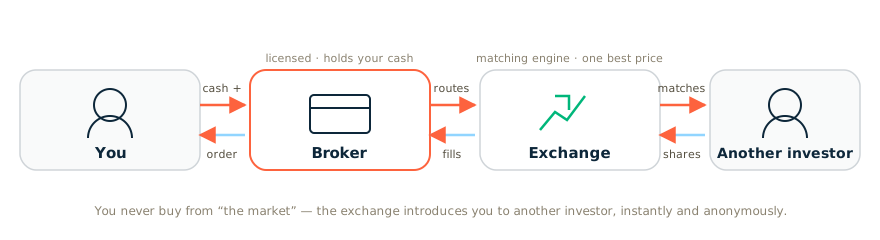
- You → your broker. A broker is a licensed company (usually an app or a bank service) that holds your cash, takes your orders and is legally allowed to trade on exchanges. Opening a brokerage account is like opening a bank account with a trading desk attached.
- Your broker → the exchange. The exchange (New York Stock Exchange, Nasdaq, London Stock Exchange…) is a giant, highly regulated matching engine: a place where every buy order meets every sell order, with prices visible to everyone. Brokers are its members; you are their guest.
- The exchange → another investor. Here's the part beginners miss: you almost never buy from "the market" or "the company" — you buy from another person or fund who decided to sell at that moment. The exchange just introduced you, instantly and anonymously.
Who keeps it honest?
Every layer is watched. Exchanges police trading itself; brokers are audited and must keep your assets separated from their own; national regulators (like the SEC in the United States, and their counterparts elsewhere) write and enforce the rules of the whole game. When you hear that markets are "regulated," this is the machinery it refers to. It exists because trust is the product markets sell.
Why this matters to you
Because it explains fees, speed and safety all at once: the broker charges (or subsidizes) your access — and is legally obliged to seek the best available price for your order (regulators call this duty best execution); and regulation is the reason a stranger's share reliably lands in YOUR account after you pay a stranger you'll never meet.
Try it now
- Find which exchange your anchor company trades on, in which country and in which currency. NYSE? Nasdaq? Somewhere else entirely? Apple's company profile is below; for your own anchor company, open it in the Terminal and change the symbol there.
Open AAPL.US — fundamentals in the EODHD Terminal
- Now look at the venue itself: its time zone, its opening and closing times, and the days it works. Markets are open surprisingly few hours per day — US large exchanges run 09:30 to 16:00 New York time, Monday to Friday. The US market's record is below.
- Count it. Five days out of seven, six and a half hours out of twenty-four. What fraction of the week is the matching engine actually running?
- Question to sit with: if markets are closed four-fifths of the time, when do you think prices "jump"? On the month of candles below, find the gaps between one day's close and the next day's open — Measure the biggest one. You will see the answer properly in the next lessons — and it explains many scary-looking charts.